BPO & Digital
Brace for Impact: Customer Experience BPO in the Disruptive Digital Age
Part 1: Brave New AI World

In our hyper competitive, constantly evolving and digitally fuelled experience economy, we need to pivot into a state of constant analysis, redesign and innovation to remain relevant in business, in particular our fast evolving Business Process Management industry. The disruptive impact of AI on our connected experience economy and BPM industry is enormous, and this disruption is here to stay for many years to come. Our business modus operandi is going through an unprecedented level of change that is fast, interruptive and merciless.
Virtual assistants have developed tremendously in voice recognition, natural language processing and cloud based intelligence. As platforms, they offer a growing range of access to proprietary and third party services, and are complementing traditional ways of brand communication. Along with their "clumsy" cousins, the chatbots, they are changing expectations and dynamics around customer experience management. Robotic process automation and AI solutions are already automating transactional processes, handling insurance claims and basic bookkeeping, managing investment portfolios and performing basic HR and marketing tasks.
The Decade Imperative
Gartner had forecast that by 2020 customers would manage 85% of their relationship with an enterprise without any human interaction, and that "Conversational AI first" would supersede "cloud first, mobile first" as the most important high level imperative of the decade, a trajectory that has since largely played out. Chatbot and Virtual Assistant technologies hold immense potential to provide high value 24/7 customer support, improve customer satisfaction, and significantly reduce operational costs. Juniper Research estimated those cost savings at over USD 8 billion annually by 2023.
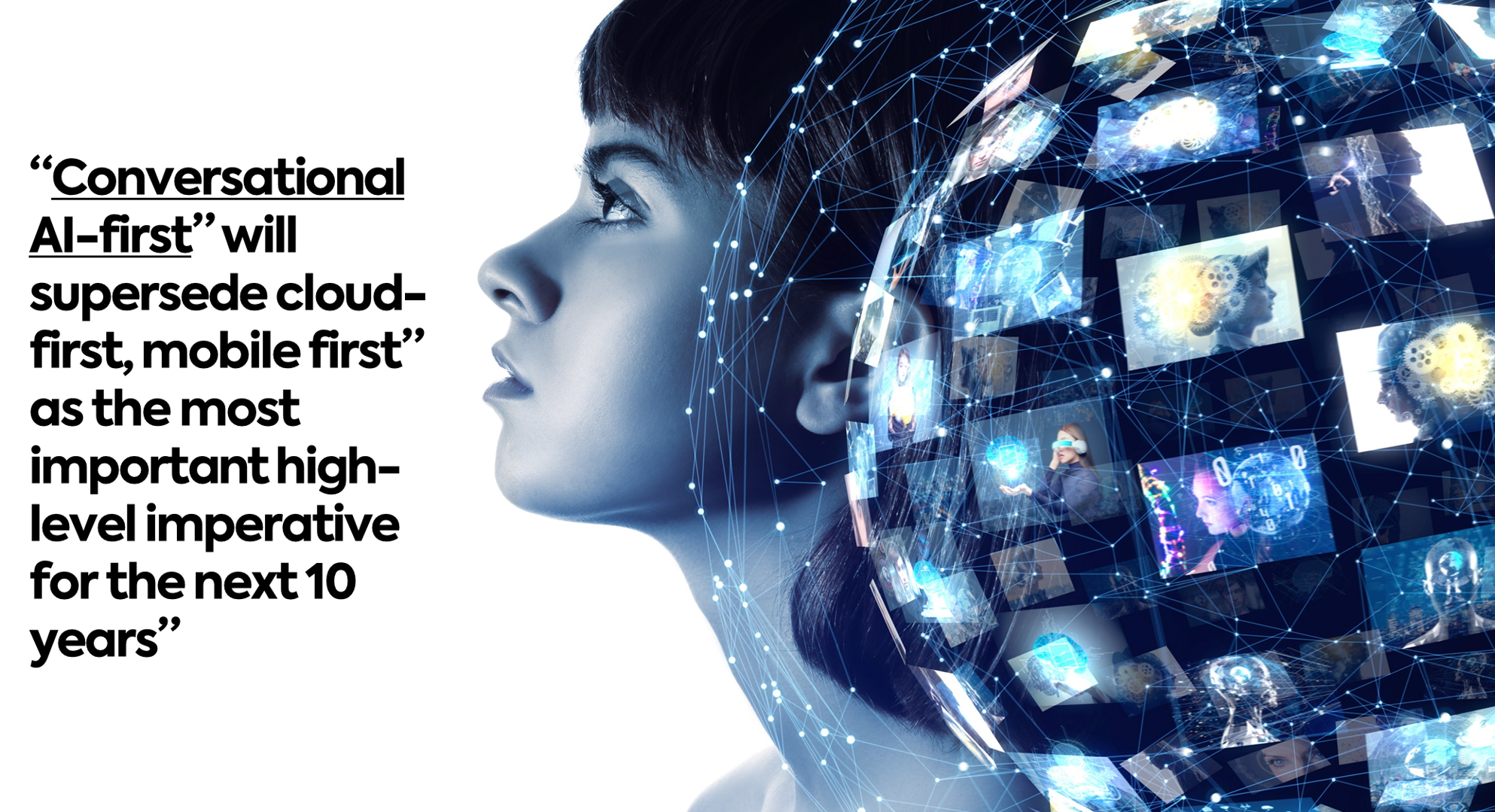
“Conversational AI first will supersede cloud first and mobile first as the most important high level imperative of the next ten years.”
The Numbers That Drove the Decade
Customer relationships managed without humans by 2020
Source: Gartner
Annual cost savings projected by 2023 through AI powered support
Source: Juniper Research
Of bots in deployment to be decommissioned or replaced by 2020
Source: Gartner
But not everything that shines is gold. Bot vendors are significantly over promising their capabilities and the ease of use for their solutions, and as a result there is a significant disconnect between business promise, reality and user expectation. Unfortunately the vast majority of bots are still highly scripted and require that the users follow the bot's scripted dialog flow. While we expect bots to be highly accurate, dynamic and with a basic common sense, the reality is that many bots fail to meet even the most conservative expectations and are merely FAQs on steroids. Gartner had predicted that almost half of the bots then in deployment would be decommissioned or replaced by 2020 for this very reason, and a large share of those first generation scripted bots were indeed quietly retired in the years that followed, as LLM powered assistants raised the bar for what a credible automated agent looks like.
Nevertheless AI solutions are bettering by the minute. Google's DeepMind and Elon Musk's OpenAI have been successful using games to teach AI systems how to learn, and those systems have already put to shame the world's greatest human players in strategy games such as Chess, Go and even Poker. This may seem trivial to many, but actually confirms that our artificial surrogates are becoming incredibly sophisticated and capable of complex decision making that can shift into real world task handling, eventually replacing humans in critical decision making tasks in security, governance and services.
The Market Shift Underway
Consumer vs. enterprise Virtual Digital Assistant users projected worldwide by 2021.
Projected industry size by 2023, up from USD 2.7 billion.
Of traditional customer service seats to be digitised out of existence by 2023.
Philippines BPO earnings in 2017, now staring at an uncertain future under AI disruption.
“People can't understand new ideas if their livelihood depends on the old one.”
Upton Sinclair
Voice BPO Hotspots
Back in 2018, smart speaker shipments alone reached a record breaking 7.5M units in Europe, according to IDC, making them one of the most rapidly adopted consumer electronics of all time. That wave reshaped consumer behaviour, and it has kept reshaping traditional service industries in the years since.
Traditional BPO players are only half heartedly embracing AI, partly due to ignorance, but also per design as their business blueprints heavily depend on mass human based interactions and labour arbitrage. Such a dramatic reduction of BPO work due to automation and AI will prove to be disastrous for BPO voice hotspots such as the Philippines, India, Egypt and South Africa unless they manage to adapt their value propositions. The Philippines economy is standing precariously on two strongholds, OFW remittances and BPO earnings, which generated USD 23 billion in 2017 alone.
The Existential Imperative
The challenge for BPO organisations lies in shifting from a "human resources" to a "human capital" mindset, adopting digital, equipping staff with crucial digital skills, and building capabilities across the workforce.
Only by morphing from people led to digital led through increasing AI capabilities will providers develop a technology enabled workforce and establish a competitive advantage in a rapidly changing service industry.
But this is easier said than done. Next generation BPOs must cut through the noise, identify the right balance between make or buy, choose partners and solutions wisely, design the right engagement and funding models, and cope with the necessary cultural, mindset and skills shifts internally.
As AI is inevitably changing the world around us, we must change along with it, or reinvent ourselves, to ensure AI turns out to be a blessing rather than a curse.
Our challenges ahead are great ones, so are our opportunities, but transcending into digital and AI is no longer a choice, it is an existential business necessity.